
Home Care vs. Home Health Care: What’s the Difference and Which Does Your Parent Need?
Mar 11, 2026
1 VIEWS
Home care and home health care sound similar but serve fundamentally different purposes and are often covered by different payers. Home care provides non-medical personal assistance with daily activities like bathing and meal preparation, while home health care includes medical services ordered by a physician such as nursing care, physical therapy, or wound management. Understanding the distinction is critical because it affects what services your parent receives, who pays for them, and when the care is appropriate—in fact, many seniors benefit from both services at different times or simultaneously.
Defining Home Care
Home care is personal assistance with activities of daily living (ADLs). It’s companionship and practical help from caregivers who are not nurses. A home care caregiver helps your parent bathe, dress, prepare meals, manage the household, take medication reminders, handle transportation to appointments and errands, and stay socially engaged.
Home care focuses on maintaining your parent’s dignity, independence, and quality of life. It’s not rehabilitative—there’s no clinical goal of recovery or healing. Rather, home care helps your parent live as independently as possible within their current abilities. If your parent has arthritis that makes showering difficult, a home care caregiver assists with that safety challenge. If cooking has become overwhelming, the caregiver handles meals. If your parent feels isolated, the caregiver provides companionship and encourages social engagement.
Home care is typically paid out-of-pocket by families, through long-term care insurance, veterans benefits, or state programs like Medi-Cal in California. Medicare does not cover traditional home care because it’s not considered medical care.
Defining Home Health Care
Home health care is medical care ordered and supervised by a physician. It includes skilled nursing services, physical therapy, occupational therapy, speech therapy, and medical social work. A registered nurse or licensed therapist delivers these services with a clear clinical goal: recovery from illness, rehabilitation after surgery, management of a chronic condition, or palliative care.
Home health care might include wound dressing changes, IV medication administration, catheter management, blood pressure and blood sugar monitoring, physical rehabilitation after hip surgery, or skilled nursing assessment for a patient declining from congestive heart failure. These are clinical interventions requiring professional medical judgment.
Home health care is medically necessary and ordered by a doctor. It typically requires a physician’s order, a care plan, and ongoing clinical oversight. Medicare often covers home health care when it’s medically necessary and when the patient is homebound or unable to leave home without significant effort and assistance.
Side-by-Side Comparison
The differences are substantial and worth clarifying.
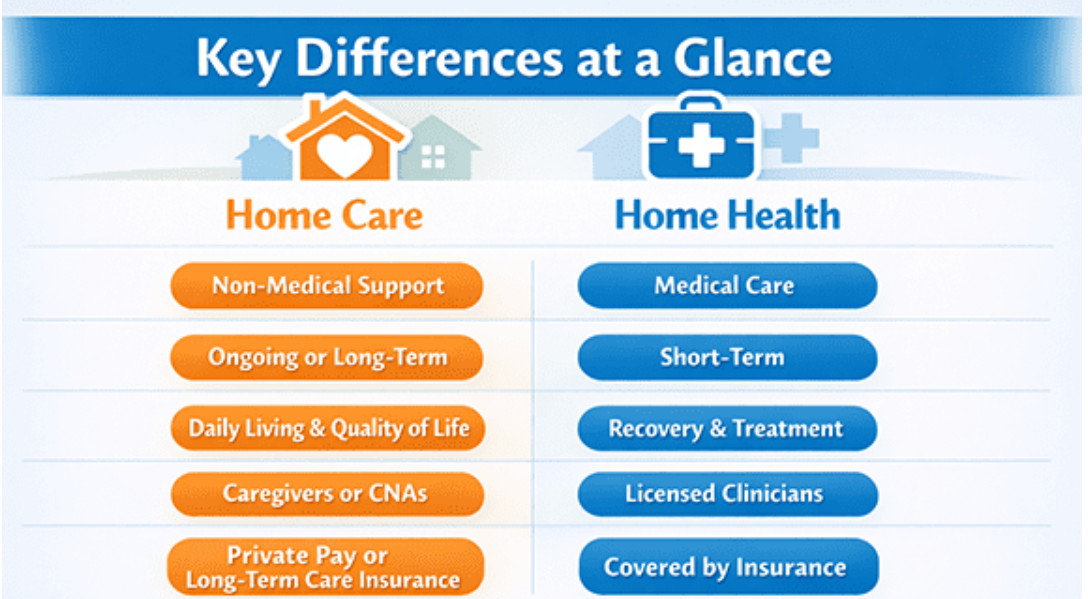
Home Care is non-medical personal assistance with ADLs like bathing, dressing, grooming, meal prep, light housekeeping, medication reminders, transportation, errands, and companionship. Caregivers are trained in personal care but are not nurses. Care is ongoing but not necessarily rehabilitative—it maintains current function. Home care is typically paid out-of-pocket or through long-term care insurance. There’s no physician order required.
Home Health Care is skilled medical care ordered by a physician, including nursing services, physical therapy, occupational therapy, or speech therapy. Services are delivered by nurses, therapists, or licensed professionals. The goal is recovery or rehabilitation—there’s a defined endpoint. Medicare often covers home health when medically necessary and patient is homebound. A physician order is required, and there’s formal clinical oversight.
In practical terms, if your parent struggles to bathe due to arthritis, they need home care. If your parent needs wound dressing changes after surgery, they need home health. If your parent is recovering from a stroke and requires physical therapy to regain mobility, they need home health. If your parent feels isolated and lonely but is otherwise healthy, they need home care.
When Medicare Covers Each
Understanding Medicare coverage is crucial when planning your parent’s care.
Medicare and Home Health Care: Medicare Part A and Part B may cover home health care when all these conditions are met: the patient is homebound, a physician orders home health services, the services are medically necessary, the patient is under the care of a physician, and the home health agency is Medicare-certified. Common scenarios include wound care after surgery, physical therapy following hospitalization, skilled nursing assessment for heart failure, or rehabilitation after stroke. Medicare coverage is typically limited to the period of active recovery or stabilization of acute conditions.
Medicare and Home Care: Medicare does not cover traditional home care because it’s not considered medical care. Personal assistance with bathing, dressing, and meal prep falls outside Medicare’s scope. This is why families typically pay out-of-pocket for home care, though some long-term care insurance policies cover it, and some state programs like Medi-Cal provide limited coverage.
This creates an important planning point: many seniors need both services at different times. For example, your parent might have a hip replacement. During the first six weeks of recovery, Medicare covers home health care including physical therapy and nursing assessment. Simultaneously, your family might hire a home care caregiver to help with bathing, dressing, and meal prep—services home health doesn’t provide. After recovery is complete and home health ends, the home care caregiver continues, supporting ongoing daily living assistance.
How Home Care and Home Health Work Together
In real-world situations, both services often complement each other beautifully.
After hospitalization, your parent comes home with medical needs and functional limitations. Home health addresses the medical piece: the nurse assesses vital signs, manages medications, monitors a recent wound, or oversees physical therapy exercises. The home health therapist works on regaining strength and mobility. But nobody on the home health team helps your parent bathe, prepare meals, or manage housekeeping. That’s where home care fills the gap. The home care caregiver ensures your parent is bathed and dressed, prepares healthy meals, keeps the home clean and safe, and provides encouragement and companionship during what can be a difficult recovery.
Over time, as your parent stabilizes and regains function, the home health services end. The physician determines the patient has recovered sufficiently or reached a rehabilitation plateau. But the home care caregiver remains, now providing ongoing support to help your parent maintain the gains they’ve made and continue living independently at home.
This partnership works beautifully when both teams communicate well. Your home health nurse and home care caregiver should be aware of each other’s work, share observations about your parent’s progress, and coordinate efforts. A good home care agency ensures their caregivers understand the medical context of their work—why your parent is experiencing certain limitations, what physical therapy goals they’re working toward, what they should watch for and report.
How to Determine Which Your Parent Needs
Ask yourself these questions:
Does my parent have acute medical needs requiring clinical assessment, wound care, medication adjustments, or physical/occupational therapy? If yes, your parent needs home health care. Talk to their physician about ordering home health services.
Does my parent need help with bathing, dressing, meal prep, housekeeping, transportation, medication reminders, or companionship—but not acute medical care? If yes, your parent needs home care.
Is my parent recovering from hospitalization or surgery and will need both rehabilitative services and personal care assistance? If yes, your parent likely needs both home health and home care simultaneously.
Is my parent chronically ill but stable—no acute medical needs, but struggling with daily living tasks due to physical or cognitive decline? If yes, your parent needs home care. Home health is designed for acute situations, not ongoing management of stable chronic illness.
Is my parent’s primary challenge functional limitation and isolation rather than medical decline? If yes, home care is the right choice.
The best way to determine your parent’s needs is an honest conversation with their physician and a professional assessment from a reputable home care agency. At Nona’s Home Care in San Diego, we conduct comprehensive in-home assessments that clarify what level of care is appropriate. If your parent needs home health first, we can help coordinate with home health services and then provide ongoing home care as recovery progresses.
Making the Transition Between Care Levels
As your parent’s health evolves, the transition between care levels is common and manageable.
Your parent might need intensive home health care for a short period, then transition to home care alone as they stabilize. Or they might need ongoing home care that’s interrupted temporarily by home health services if they’re hospitalized and return home with new acute medical needs. Communicating openly with your care providers ensures smooth transitions.
Keep your primary care physician and home care agency informed about changes in your parent’s health or abilities. If your parent develops new symptoms or medical needs while receiving home care, that’s important information for their physician. Conversely, if home health services end and your parent needs home care support, that transition should be planned and coordinated to avoid gaps in coverage.
Next Steps: Clarifying Your Parent’s Needs
If you’re unsure whether your parent needs home care, home health, or both, start with your parent’s primary care physician. Describe your parent’s current functional status, medical conditions, and day-to-day challenges. Ask the physician whether home health services would be medically appropriate and whether they’d be willing to write an order if needed.
Simultaneously, contact a home care agency like Nona’s Home Care for a no-obligation assessment. We’ll evaluate your parent’s practical care needs, identify what assistance would make the biggest difference in their quality of life and independence, and discuss how home care could fit into their overall care plan.
If your parent needs home health first, we can help you navigate that process and position home care to begin when home health ends or to run simultaneously if that makes sense for your family’s situation.
Frequently Asked Questions
Q: Can home health services and home care happen at the same time?
A: Absolutely. Many seniors benefit from both services simultaneously—home health for medical rehabilitation and home care for personal assistance and daily living support. The two services complement each other.
Q: Does Medicare ever cover home care?
A: No, Medicare does not cover personal care assistance (bathing, dressing, meal prep). However, some long-term care insurance policies, veterans benefits, and state programs may help cover home care costs.
Q: How do I know if my parent is “homebound” for Medicare home health purposes?
A: Generally, homebound means your parent has a documented medical condition that restricts their ability to leave home, and leaving home requires significant effort and assistance. Your physician determines homebound status when ordering home health services.
Q: What happens when home health services end?
A: Your physician decides when your parent has recovered enough or reached a rehabilitation plateau that home health is no longer medically necessary. At that point, home health ends. Home care can continue indefinitely as long as your parent needs personal assistance.
Q: How do I coordinate between home health nurses and home care caregivers?
A: Choose a home care agency that emphasizes communication and coordination. They should train caregivers to work alongside home health professionals, share observations, and respect each other’s role in your parent’s care.
Not Sure What Your Parent Needs?
The good news is that clarity is just a conversation away. Whether your parent needs medical care, personal care, or both, the first step is assessment and honest discussion about their actual needs and goals.
Call Nona’s Home Care for a free, no-pressure in-home assessment. We’ll listen to your situation, observe your parent’s capabilities and challenges, and help you understand what level of care makes sense. If your parent needs home health first, we’ll help coordinate that process. When they need home care—whether now or in the future—we’re here to provide the skilled, compassionate support that keeps your parent living independently at home with dignity and peace of mind.
Nona’s Home Care: San Diego’s trusted partner in home care and senior independence.
*This information is general in nature. For specific medical recommendations, consult your parent’s healthcare provider.*